Why Are Law Firms Moving from Manual Demand Letters to AI?
AI-assisted demand letters turn complex case documents into clear, attorney-ready drafts. This helps law firms save time, reduce effort and work more efficiently.
Law firms are busy—and getting busier. Drafting a demand letter manually can be time-consuming and stressful, especially when attorneys review and organize large volumes of medical records. That’s why many firms are turning to AI-assisted demand letters, which reduce administrative workload, ensure consistency across cases, and improve turnaround times—allowing attorneys to focus on strategy and negotiation.
Before exploring how AI works, let's first understand how demand letters are prepared manually and where AI can make a difference.
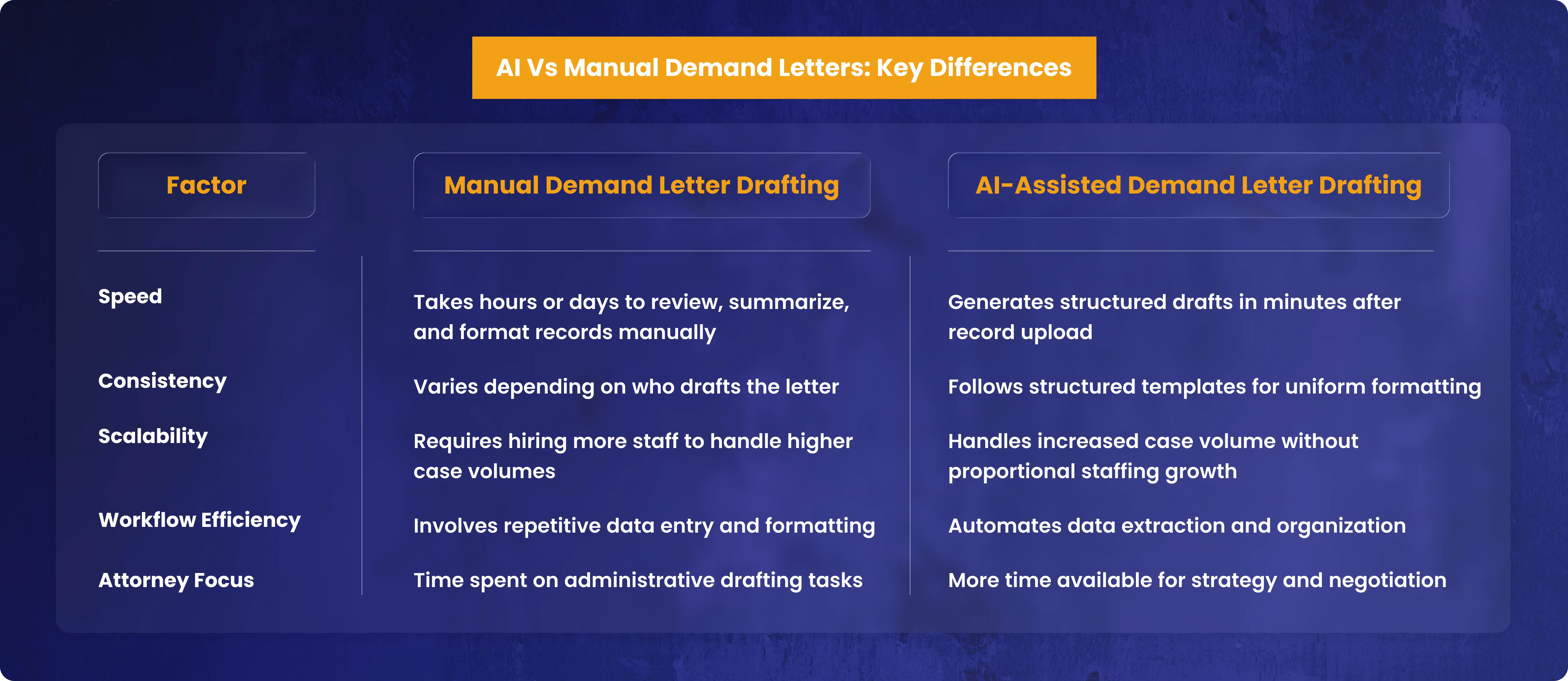
Manual vs. AI Demand Letter Drafting: What’s the Difference?
This process can take several hours per case. In complex cases, it may take days.
AI-Assisted Demand Letter Drafting Workflow
Understanding the workflow removes confusion around modern drafting tools.
Upload medical records
Extract treatment timelines
Identify diagnoses and procedures
Organize medical expenses
Generate a clear and accurate injury summary
Structure the damages
Create a complete draft demand letter
The attorney reviews, edits, and finalizes the document
This significantly reduces manual review time while maintaining attorney oversight.
Cut Drafting Time by 70%
Technology-assisted workflows allow law firms to create structured, accurate demand letters much faster than manual drafting.
How AI Transforms Demand Letter Drafting
AI-assisted demand letter drafting is more than just typing faster or formatting documents. It involves intelligently understanding case data. It structures that information to support stronger legal arguments. It also provides insights that were almost impossible to generate manually.
Here’s how AI helps in demand letter drafting.
Intelligent Medical Record Analysis
Challenge: Reviewing hundreds or thousands of medical records manually is slow and can lead to missing important information.
AI Solution: Modern tools use natural language processing (NLP) to read, understand, and categorize information from unstructured medical records.
How it Works:
It identifies important events like surgeries, ER visits, and follow-up treatments.
It detects patterns, such as repeated complaints or delayed diagnoses, which could influence liability.
It identifies inconsistencies automatically, for example, a therapy session that was scheduled but not performed.
Example: In a spinal injury case, AI can automatically extract
Accident date
ER visit
Surgery
Physical therapy
Ongoing pain.
This saves hours and also prevents missed critical points.
Summarizing Injuries with Contextual Insight
Challenge: Manual summaries often reduce injuries to simple lists, which can overlook important details about how the injuries affect the client’s daily life and well-being.
AI Solution: AI clusters injuries by type—physical, emotional, and financial. It generates structured summaries with contextual relevance.
How it Works:
It reads detailed notes and extracts functional impacts, such as “limited mobility, difficulty working, emotional distress.”
It organizes them in logical order, highlighting causality and severity.
Example: Instead of writing “Client has a knee injury,” AI can generate a clearer summary such as:
"The client suffered a knee ligament injury on June 10, 2025. The injury required medical treatment and eight physical therapy sessions, which limited the client’s ability to walk normally and perform daily activities."
Automated Calculation of Damages
Challenge: Calculating damages for a case can be a time-consuming task for both economic damages (medical expenses, lost income) and non-economic damages (pain, suffering).
AI Solution: The AI tool can identify data points in a case, cross-reference medical expenses, income statements, or therapy sessions, and organize them in a way that can be used for calculation.
How it Works:
Economic Damages: Calculating medical expenses, rehab expenses, and lost income.
Non-Economic Damages: Highlighting documented pain, suffering, or mental health impacts for attorney emphasis.
Estimating future expenses by utilizing past trends or standard therapy sessions.
Example: AI identifies that a physical therapy session was missed due to a clinic scheduling error, which extended the recovery period. This may justify additional therapy costs and higher compensation in the damages calculation.
Enhancing Negotiation and Settlement Strategy
Challenge: Preparing a accurate demand letter is only part of the battle. Attorneys also need to anticipate insurer responses and optimize negotiation strategies.
AI Solution: Tools analyze historical data from similar cases. They provide insights into likely settlement ranges and potential objections.
How it Works:
Insurer negotiation tactics are typically highlighted.
Suggestions are provided to adjust the draft in order to strengthen arguments or address predictable objections.
Example: If an insurer questions whether therapy after six weeks is necessary, the attorney can explain why continued treatment is still needed.
Ready to get started? Get free trial worth $500. Hurry up!
Every technological advancement comes with responsibility. Law firms must adopt these tools thoughtfully.
Possible Risks:
Over-reliance on automation
Technology is a tool, not a decision-maker. Sending drafts without proper review can lead to errors.
Data privacy concerns
Medical records contain sensitive information. Secure systems and regulatory compliance are essential.
Loss of personalization
If not carefully reviewed, drafts may feel generic. Attorneys must add case-specific narrative, emotional context, and strategic framing.
Ethical responsibility
Attorneys remain fully responsible for the final document. Professional accountability does not change.
“AI-assisted demand letters don’t replace attorneys—they amplify efficiency, accuracy, and strategic control in every case.”
What Happens If Law Firms Don’t Adopt AI for Demand Letters?
Technology adoption in legal workflows is no longer optional. It is becoming part of standard practice.
Firms that continue relying only on manual demand letter drafting may begin to face challenges such as:
Slower case turnaround times
Increased administrative costs
Overworked staff
Inconsistent documentation quality
Delayed settlement cycles
Meanwhile, firms using structured AI-assisted workflows can:
Prepare demand letters faster
Handle higher case volumes
Maintain consistent documentation
Respond quickly to insurer requests
Improve operational efficiency
Over time, this difference compounds.
If one firm can send a well-prepared demand in two weeks while another takes six, clients will notice. Referral sources will notice the difference. Cash flow patterns will reflect it. The legal industry is competitive. Efficiency is becoming a differentiator.
This does not mean every firm must fully automate. But ignoring workflow improvements entirely may create operational disadvantages in the long term. Firms that adopt technology thoughtfully — with proper review and oversight — are positioning themselves for scalability and sustained growth.
Why AI Demand Letters Matter
70%
Faster Drafting
AI extracts records and timelines quickly, saving hours.
50%
Higher Accuracy
AI drafts reduce errors and capture all key facts.
85%+
Consistent Output
Standardized formats keep teams aligned and uniform.
Frequently Asked Questions About AI Demand Letter Drafting
What Is an AI Demand Letter?
A technology-assisted demand letter is a settlement demand drafted using specialized software that analyzes medical records, case details, and damages to create a structured legal document.
Is AI demand letter drafting accurate?
When paired with skilled human review, accuracy rates reach as high as 99% — making it more reliable than rushed manual drafting.
Do insurance companies accept AI-assisted demand letters?
Yes. Insurers focus on the quality and documentation of the demand letter, not how the first draft was created.
Are AI-generated demand letters legally valid?
Yes. Attorney review and approval are what give a demand letter its legal weight — not how the first draft was prepared.
How long does it take to prepare a demand letter with AI?
Most firms turn around a complete demand within 48 hours — a timeline that manual drafting alone simply cannot match consistently.
How much does an AI demand letter drafting cost?
Most services charge for each case. It usually costs less than the time and money spent when lawyers or staff write the demand letter manually.
What information is needed to draft a demand letter?
Medical records, billing statements, lost wage proof, treatment history, and liability facts form the foundation of any strong demand.
Does AI affect the quality of demand letters?
No. Attorneys still control the legal strategy and final quality of the document.
Is client information safe when using AI for demand letter drafting?
Yes. Most professional AI tools follow strict security standards to protect sensitive client and case information.
Does AI improve settlement outcomes?
AI improves documentation and organization, but settlement outcomes depend on attorney's negotiation and strategy.
Choosing the Right Outsourcing Partner: Why Law Firms Trust LezDo TechMed
Modern drafting support is not about replacing attorneys — it is about strengthening workflows and improving reliability.
At LezDo TechMed, we combine structured technology with 200+ board-certified legal and medical professionals to deliver measurable results:
48-hour turnaround time
99.8% accuracy rate through layered quality review
13+ years of industry experience
We provide comprehensive demand letter writing services, ensure that every demand draft is structured, evidence-aligned, and attorney-ready — helping law firms reduce administrative burden without compromising standards. Choosing the right outsourcing partner is not just an operational decision — it’s a strategic one.
Source Credit : All metrics derived from LezDo TechMed’s internal project data.
Vishnu Priya Vinu
Vishnu Priya Vinu is a Certified Legal Nurse Consultant (LNC) and Medical-Legal Research Analyst with over two years of experience in medical record review, medico-legal research, and content development. She specializes in blogs, articles and E-books that bridges the gap between healthcare and law. Her strong medical background brings depth and accuracy to content, enabling law firms, medical evaluators, and insurance professionals to gain insights on complex medical data analysis. She delivers evidence-based insights and strategic content that strengthen case outcomes and support informed decision-making.












.png)