Home
>
Blog
>
>
The Most Useful Damages Testimony Often Appears Outside the “Injuries” Section
- The injuries section may name the condition but omit how the witness says life changed afterward.
- Employment testimony can contain job modifications, missed work, reduced hours, and reasons for leaving a role.
- Daily-activity answers often reveal frequency, duration, assistance, pacing, and good-day versus bad-day differences.
- Treatment testimony can show time burden, travel, side effects, interruptions, and barriers without proving why they occurred.
- Prior-condition and subsequent-incident testimony should remain separate from the claimed post-incident change.
- Every material damages statement should remain traceable to its question, answer, correction, exhibit, and page-line location.
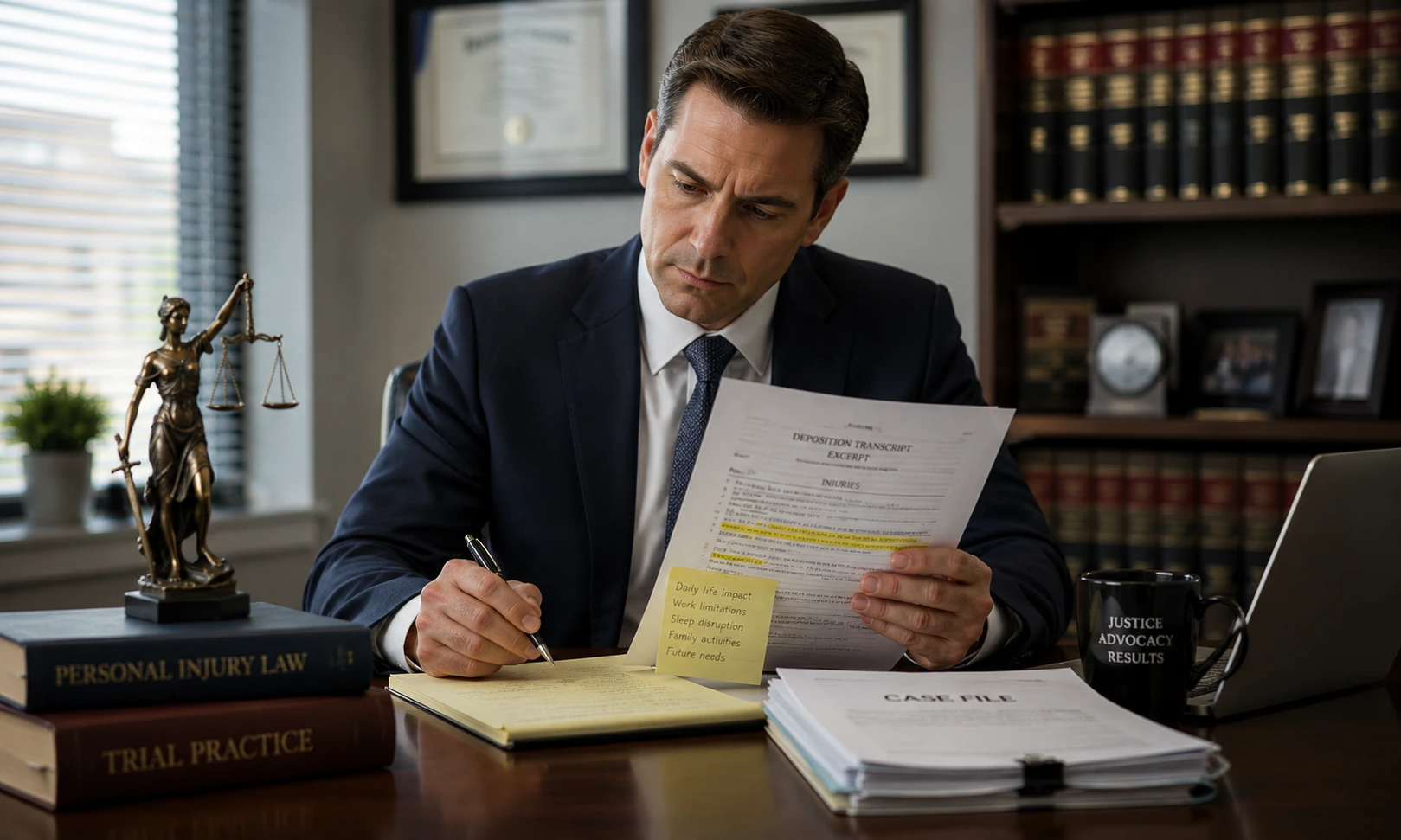
The most useful damages testimony often appears outside the injuries section because witnesses describe loss while discussing employment, household tasks, recreation, treatment decisions, prior conditions, expenses, and exhibits. A useful deposition summary therefore tracks claimed change across issues and time, preserves the witness’s qualifications, and cites the exact page and line. The sections below show where that testimony tends to surface and what a reviewer should retain.
Why the “Injuries” Section Rarely Contains the Full Damages Story
The injuries section rarely contains the full damages story because it usually concentrates on body parts, diagnoses, symptoms, and the immediate event. Damages-related testimony is broader. It may involve what work the plaintiff performed before the incident, what tasks changed, who began helping at home, which activities stopped, and what treatment demanded from the person’s schedule.
A transcript heading can create a false boundary. Once questioning moves to education, employment, family, recreation, finances, or prior medical history, a reviewer may treat the testimony as background. Yet those sections often contain the clearest before-and-after descriptions in the deposition.
That is why source-faithful accuracy checks should test issue coverage as well as wording. A sentence can be accurately condensed and still be misplaced, disconnected from its time period, or omitted from the damages map entirely.
The Strongest Damages Testimony Often Sits Under Ordinary Headings
Employment, daily activities, treatment, prior history, expenses, and exhibit exchanges can each add a different part of the witness’s claimed before-and-after account.
Employment Testimony Can Reveal the Practical Work Change
Employment testimony can reveal damages-related facts by showing the job demands before the incident and the changes the witness reports afterward. Titles alone are thin. The useful testimony concerns lifting, standing, driving, keyboard use, travel, production quotas, overtime, schedule changes, assistance from coworkers, missed shifts, reduced hours, and the stated reason for each change.
Time matters here. A plaintiff may have stopped work for two weeks, returned with restrictions, resumed full duties, then changed roles months later for a separate reason. If a summary compresses that sequence into ‘unable to work after the accident,’ it changes the shape of the testimony.
The summary should separate what the witness personally testified from what an employer, physician, disability form, or wage record may document. It can flag that another source was mentioned and preserve the page-line reference. The attorney determines how the testimony fits the claimed economic loss.
Daily Activities Supply the Detail Behind Functional-Loss Claims
Daily-activity testimony supplies damages detail by showing what the witness says changed in routine life, how often it changed, and what help became necessary. Household cleaning, cooking, shopping, childcare, personal care, sleep, driving, exercise, hobbies, travel, and community activities may each reveal a different limitation.
The useful details are often qualifiers. ‘I cannot cook’ may later become ‘I cook simple meals twice a week but need help lifting pots.’ ‘I stopped exercising’ may mean the witness stopped running but continued walking. Those distinctions belong in the summary because they preserve the scope of the answer instead of turning it into a broader claim.
Stable issue labels and page-line placement make daily-life testimony easier to scan and verify. The entry should also identify the time period, since function shortly after an incident may differ from function at the deposition date.
Treatment Testimony Shows Burden, Interruption, and Response
Treatment testimony can reveal a claimed damages burden through appointment frequency, travel, recovery time, medication effects, home exercises, missed work, out-of-pocket statements, and the witness’s account of improvement or worsening. These details may appear during questions about providers or chronology rather than under damages.
A careful summary keeps different evidence types apart. The witness may testify that a physician recommended surgery, but the recommendation itself should be checked against the referenced record when available. The witness may also explain why treatment paused, such as scheduling, transportation, cost, insurance, work, caregiving, or personal choice. The summary should report the explanation as testimony, not convert it into a clinical or legal conclusion.
Treatment response also needs dates. A procedure may have helped one symptom temporarily while another remained unchanged. Condensing the entire course into ‘treatment failed’ can erase what was actually said and make later verification harder.
Review topic-based, pagewise, narrative, chronological, and page-line examples to see which structure fits your next transcript.
Compare Formats Before Choosing How Damages Testimony Should Be Organized
Prior Conditions and Later Incidents Establish Separate Time Frames
Prior-condition and later-incident testimony establishes separate time frames that a damages-focused summary must keep visible. The reviewer should organize what the witness described before the subject event, immediately afterward, during recovery, after any later event, and at the time of deposition.
Similarity in body part does not establish sameness in symptoms, severity, function, or cause. The transcript may describe an earlier episode that resolved, an intermittent condition, continuing treatment, or a later event affecting the same area. Each statement needs its own date range and page-line source.
This is a common point of compression failure. A broad label such as ‘prior back pain’ may conceal whether the witness described one visit ten years earlier or continuing care through the week before the event. The summary organizes the accounts. Qualified professionals decide their significance.
Expense and Household Help Testimony Adds Claimed Losses
Expense and household-help testimony adds damages-related facts by identifying what the witness says was paid, postponed, replaced, or performed by someone else. Transportation, medication, equipment, home assistance, childcare, and paid services may surface during financial or family questions, far from the injuries section.
A summary should retain whether an amount was exact, estimated, recurring, reimbursed, unpaid, or recalled without documents. The same restraint applies to household help. Identify the task, who performed it before and after the incident, how often help was needed, and the relevant period when the witness supplied those details.
The reviewer should not calculate damages value or treat testimony as proof of payment. The job is to make the statement, limitation, and cited source easy for counsel to evaluate beside bills, receipts, wage material, and other discovery.
Exhibits and Corrections Can Change the Damages Entry
Exhibits, corrections, and follow-up questions can change a damages entry because the witness may narrow, expand, or correct an earlier answer after seeing a document. A calendar may refresh the date of missed work. A photograph may clarify the activity shown. A medical note may prompt the witness to distinguish current symptoms from an earlier complaint.
The summary should preserve the sequence: the first answer, the exhibit shown, the revised or qualified answer, and each supporting page-line citation. An objection or rephrased question may also change the scope of the response. Removing that sequence can make the final statement look firmer than the testimony was.
A practical method is to track the exhibit and the changed answer as one linked entry. Counsel can then return to the exact exchange and decide how it should be used.
“A body-part list tells you what the witness named. A damages map shows where the witness said life changed.”
Build the Summary Around a Damages Testimony Map
A damages testimony map should group material statements by claimed effect while preserving chronology, source, and uncertainty. The point is to let the plaintiff attorney find every relevant account without pretending that each statement has equal support or legal weight.
Start with matter-specific headings. A motor-vehicle case may require symptoms, treatment burden, work, household function, mobility, recreation, expenses, prior history, later incidents, and future-care statements. Another matter may need different labels. The assignment should control the map.
Each material entry should answer a small set of questions:
- What did the witness say changed?
- What was the stated before-and-after comparison?
- Which period did the answer cover?
- Was the statement qualified, estimated, corrected, or based on limited memory?
- Did an exhibit or another question change the answer?
- Where are the exact transcript page and line references?
- Was another source mentioned for counsel to compare?
The final quality check should search beyond the selected headings. Reviewer notes and transcript searches for work, help, sleep, driving, lifting, bills, medication, hobbies, travel, and similar terms can locate candidate passages. Human review then decides whether the surrounding question and answer belong in the summary. Search finds words. Context determines the usable entry.
Current Deposition Summary Service Benchmarks
15,000+
Depositions Summarized
Company-level annual volume
1-2 days
Standard Turnaround
Company-level average, not a case guarantee
200+
Pages per Deposition
Company-level average transcript length
Frequently Asked Questions
What is a damages-focused deposition summary?

A damages-focused deposition summary organizes testimony about claimed symptoms, function, work, treatment burden, expenses, assistance, and related changes. It presents what the witness said with page-line references and does not determine damages value.
Where does damages testimony usually appear in a deposition?
Damages testimony often appears in employment history, daily activities, treatment, family responsibilities, finances, prior medical history, later incidents, and exhibit discussions. Reviewers should search across the entire transcript rather than rely on one heading.
Should a deposition summary assess whether damages testimony is credible?
No. A deposition summary can preserve inconsistencies, qualifications, corrections, and source conflicts, but credibility assessment belongs to the attorney or other qualified decision-maker.
How should activities of daily living be summarized?
Activities of daily living should be summarized with the task, claimed change, frequency, assistance, time period, and any good-day or bad-day qualification the witness provided. The entry should retain the exact page-line citation.
How should prior injuries be handled in a damages summary?
Prior injuries should be placed in a separate time frame and described using the witness’s actual testimony about symptoms, treatment, function, and resolution. The summary should not assume that a shared body part proves the conditions were the same.
Why do page-line references matter for damages testimony?
Page-line references let counsel verify the question, answer, qualification, and nearby follow-up before using the testimony. They are especially important when a broad summary phrase could hide a narrow answer.
What should happen when an exhibit changes a witness’s answer?
The summary should record the initial answer, identify the exhibit, preserve the changed or qualified answer, and cite both transcript locations. It should not silently replace the first answer with the later one.
Which deposition summary format works best for damages testimony?
A topic-based or hybrid format often helps counsel retrieve damages issues, while page-line structure supports close verification. The best choice depends on the matter, the number of witnesses, and how the legal team will use the summary.
The Bottom Line
The most useful damages testimony appears wherever the witness describes a change in work, function, treatment burden, spending, assistance, or routine. A deposition summary that looks only under injuries may capture the diagnosis and still miss the lived account that plaintiff counsel needs to review.
The practical test is simple: can the attorney locate the claimed before-and-after change, see its time frame and limitations, and return to the exact testimony without reconstructing the transcript? If one of those pieces is missing, the damages entry is not ready for reuse.
Refer to our blog, ‘Why a Deposition Summary Should Preserve Context Before Shortening the Transcript,’ to learn how questions, corrections, objections, exhibits, and page-line references protect the meaning of condensed testimony.
Source Credit : All metrics derived from LezDo TechMed’s internal project data.
Jebisha Jenishofen
Jebisha Jenishofen is a Certified Legal Nurse Consultant and Medical–Legal Research Analyst with over five years of experience in the medical-legal industry. She specializes in medical record analysis, medical-legal research, and content development, creating clear and informative resources on personal injury, medical malpractice, insurance claims, and healthcare litigation. By combining clinical knowledge with research expertise, she transforms complex medical information into practical insights for medical-legal professionals.













.png)