Home
>
Blog
>
>
The Testimony Drift Problem: Why a Deposition Summary Should Track How a Witness's Story Changes
Before you rely on a deposition summary, ask whether it tracks how the testimony changed:
- Did the witness correct, soften, or expand an earlier answer?
- Did an exhibit or medical record change the response?
- Did the testimony conflict with prior statements or treatment records?
- Did the witness become less certain when pressed for dates, symptoms, or limitations?
- Can the attorney trace the shift back to exact page-line references?
The first answer is not always the real answer.
Sometimes the witness starts confident. Then the timeline gets tighter. A medical record is shown. A prior statement is read back. A date is corrected. A symptom suddenly becomes “maybe,” “not sure,” or “I would have to check.”
That shift matters.
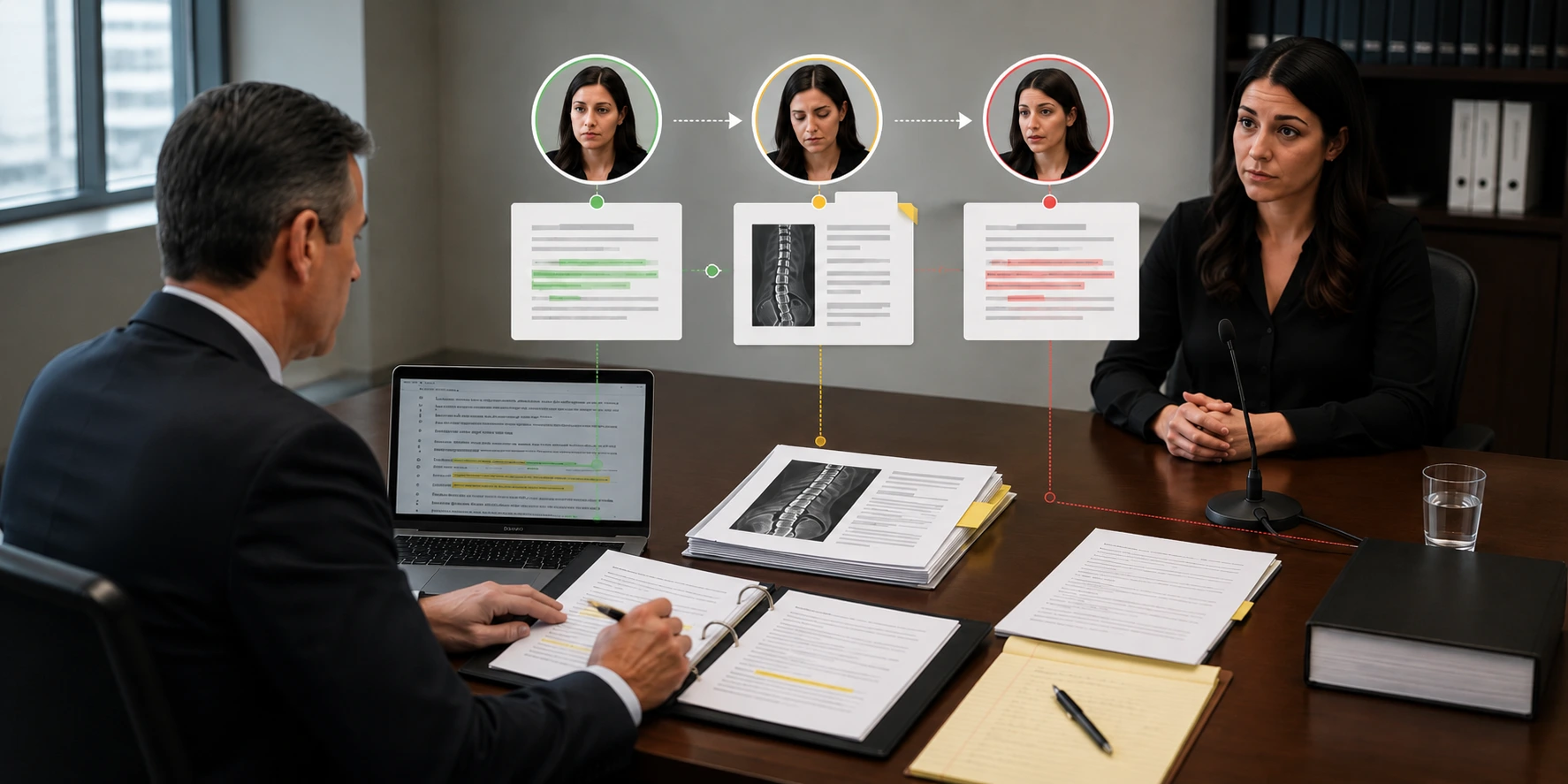
In litigation, testimony drift is the slow movement of a witness’s story across the deposition. It may happen over five pages or fifty. It may be obvious, or it may hide inside small wording changes. A strong deposition summary should help attorneys see that movement clearly, without forcing them to reread the full transcript every time the case is reviewed.
Why Testimony Drift Matters
A deposition is not a clean story. It is a live conversation under pressure.
A witness may begin with a broad answer: “I never had back pain before the accident.” Later, after reviewing prior records, the answer may become: “I may have mentioned some back soreness years ago, but it was different.” That may not destroy the claim. It may not even be a contradiction. But it is a change, and attorneys need to see it.
In personal injury and medical-legal cases, testimony drift can affect how the legal team evaluates injury history, treatment consistency, prior conditions, functional limitations, damages, and impeachment risk.
A basic summary may capture both answers separately. A better summary connects them.
A useful deposition summary does not simply record what was said. It shows when the witness's story moved and what caused that movement.
A Good Summary Tracks Testimony Drift
A strong deposition summary shows when a witness’s story changes, what caused the change, and why that shift may matter to the legal team.
The First Answer Can Be Too Clean
Early deposition answers often sound simple because the witness has not yet been tested against dates, records, bills, imaging, or prior complaints.
That is why the first answer should not always be treated as the final position. A witness may later clarify that they misunderstood the question. They may remember additional treatment after seeing a provider name. They may change symptom dates after reviewing a record. They may admit uncertainty once counsel narrows the question.
A good summary should preserve that progression. It should help the attorney understand whether the witness stayed consistent, clarified reasonably, or drifted into a weaker position.
That distinction matters during mediation, expert preparation, cross-examination, and trial planning.
Exhibits Often Create the Shift
Many testimony changes happen after an exhibit is introduced.
A medical record may refresh memory. A prior claim file may reveal earlier treatment. A diagnostic report may challenge the witness’s timeline. A therapy note may show functional complaints before or after the date the witness gave.
When the summary separates the answer from the exhibit that shaped it, the legal team loses context.
For example, it is useful to know that the witness acknowledged prior neck pain. It is more useful to know that the acknowledgment came only after counsel showed a primary care note from two years before the incident.
That does not mean the summary should argue the point. It should simply show the connection:
- What the witness first said
- What document was shown
- What the witness changed or clarified
- Where the supporting page-line reference appears
- Whether the answer remained uncertain or became definite
That is practical litigation value.
Wondering how testimony progression is preserved?
Small Word Changes Can Carry Big Meaning
Testimony drift is not always dramatic. Sometimes it lives in small phrases.
“I could not work” becomes “I had trouble working.”
“I never missed appointments” becomes “I do not remember missing any.”
“The pain started immediately” becomes “I noticed it later that day.”
“I had no prior treatment” becomes “not for the same problem.”
These are not all fatal contradictions. Some are fair clarifications. Some are memory issues. Some may be harmless. But they should not disappear in a summary that only captures broad topics.
A strong deposition summary should keep the wording careful enough that attorneys can judge the value of the testimony themselves.
The Summary Should Not Decide Credibility
This is important.
A deposition summary should not label the witness as dishonest. It should not decide liability, damages, causation, negligence, or credibility. Those decisions belong to the attorney and the proper legal process.
The summary’s role is narrower, but still powerful. It should organize the testimony so the legal team can see:
- Statements that stayed consistent
- Statements that changed after questioning
- Answers tied to exhibits or records
- Uncertain, qualified, or evasive responses
- Page-line references for verification
That boundary keeps the work useful and defensible.
"Small changes in testimony can matter, but the summary should present those changes clearly and leave credibility judgments to the legal team."
How Testimony Drift Affects Case Preparation
When testimony drift is visible, attorneys can prepare with fewer surprises.
Before mediation, it helps the team understand which parts of the witness story are strong and which need explanation. Before expert review, it helps identify testimony that should be compared with medical records. Before trial, it helps counsel plan cleaner direct examination or sharper cross-examination.
For paralegals and litigation support teams, it also reduces transcript re-reading. Instead of searching hundreds of pages to find where a statement changed, the summary gives a clear path back to the key exchange.
That is especially useful in cases involving long treatment histories, multiple providers, prior injuries, disputed symptoms, or conflicting accounts of daily limitations.
What a Drift-Aware Deposition Summary Should Include
A deposition summary built for litigation use should do more than shorten the transcript. It should preserve movement, context, and verification.
At minimum, it should capture:
- Key admissions and important denials
- Changes or clarifications in testimony
- Exhibit-driven answers
- Medical, injury, and damages-related statements
- Exact page-line references for key testimony
- Open questions that may need record comparison
This turns the transcript into a working case tool, not just a shorter document.
The LezDo Review Standard
LezDo TechMed prepares deposition summaries by organizing sworn testimony into clear, review-ready formats based on the agreed case scope. The work may include topic-based summaries, page-line summaries, narrative summaries, chronological summaries, and customized formats.
For legal teams that need structured support, deposition summary services can help condense lengthy transcripts while preserving key admissions, contradictions, testimony shifts, and page-line references.
LezDo TechMed does not determine credibility, liability, damages, negligence, standard of care, or legal strategy. The summary presents documented testimony so attorneys and qualified legal professionals can evaluate it in context.
Proof Points From LezDo
- 15,000+ depositions summarized annually
- 1-2 days standard turnaround
- 200+ pages average deposition length
- 10:1 average compression ratio
These figures reflect LezDo TechMed company-level performance data shown on its deposition summary services page, not a guarantee for every individual file.
Drift-Aware Deposition Summaries. Better Litigation Preparation.
78%
Testimony Changes Clearly Identified
Fewer Preparation Surprises
86%
Key Exchanges Linked to Page-Line References
Faster Transcript Verification
93%
Admissions, Denials, and Clarifications Preserved
Stronger Case Review
Frequently Asked Questions
What is testimony drift in a deposition?

Testimony drift happens when a witness’s answers change, soften, expand, or become less certain during questioning. It may happen after follow-up questions, exhibits, prior records, or timeline clarification.
Why should a deposition summary track testimony changes?
Tracking changes helps attorneys identify contradictions, clarifications, impeachment points, and testimony that may need comparison with medical records or other evidence.
Should a deposition summary decide whether a witness is credible?
No. A deposition summary should not decide credibility or legal conclusions. It should organize the testimony and provide page-line references so attorneys can evaluate the issue.
What makes a deposition summary useful for litigation?
A useful summary captures key testimony, context, exhibit-related answers, changes in witness statements, and exact transcript references in a format attorneys can quickly review and verify.
Final Thought
The danger in a deposition is not always the answer that sounds bad immediately. Sometimes it is the answer that changes slowly.
A witness may start with certainty, soften after a document, clarify after follow-up questions, or move away from an earlier statement without making a dramatic admission. If the summary does not track that movement, the legal team may miss the real value of the testimony.
A strong deposition summary should help attorneys see what the witness said, how the answer developed, and where the story started to shift. That is where deposition review becomes more than transcript reduction. It becomes litigation clarity.
Source Credit : All metrics derived from LezDo TechMed’s internal project data.
Shabila Thomas
Shabila Thomas is a Certified Legal Nurse Consultant (CLNC) and Medical-Legal Research Analyst with over two years of experience in medical record review, medico-legal research, and content development. She specializes in blogs, articles, and content that decode complex medical information, industry trends, and regulatory updates for the medico-legal field. Her clinical background and research-first approach help law firms, medical evaluators, and insurance professionals understand complex medical data, identify relevant insights, and make faster, better-informed decisions.













.png)