Building Stronger Relationships Between Evaluators and Attorneys
When evaluators and attorneys work as true partners, cases move faster, opinions become clearer, and outcomes improve for everyone involved.
Are you an evaluator or attorney struggling to build a strong, collaborative relationship with your counterpart?
Relationships with attorneys and evaluators are important for successful legal cases. Attorneys depend on evaluators to provide opinions that can stand up in court, while evaluators rely on them for the right context and clear instructions.
When you two have a good working relationship, both of you can build strong cases and achieve fair outcomes for clients. When your relationship is weak, misunderstandings can happen, and cases can suffer.
Building strong relationships requires trust, open communication, respect, and a clear understanding of each other’s roles.
This article explores why these relationships matter, what challenges often arise, and how both sides can work together more effectively.
Why Evaluators and Attorneys Need Each Other
The attorney-evaluator relationship is not just about sharing reports or opinions. It is about creating a partnership that enhances the quality of legal work. Attorneys need evaluators to explain information outside their scope, such as medical diagnoses, psychological assessments, or technical details of a case.
For instance, in a personal injury case, an attorney needs a patient’s long-term impact of an injury. He needs the evaluator to explain those things. If the evaluator does not know the legal side of the case, like whether the injury causes permanent disability, their report will not give what the attorney needs.
A strong relationship understands each other’s ultimate goal and stays focused on that.
Improve Case Efficiency by 60%
Strong communication and collaboration between evaluators and attorneys can reduce review delays and misunderstandings by 50–60%.
Common Challenges in Building Strong Relationships
Lack of Communication
In an attorney-evaluator relationship, a lack of communication can be a barrier. Sometimes, attorneys may send limited records or incomplete background information of the plaintiff. In that case, an evaluator may struggle to provide accurate information. Likewise, evaluators may not always express what additional information they need. When both communicate clearly about what is required, it makes the review more accurate and valuable.
Different professional cultures
Attorneys and evaluators often come from different professional backgrounds. Evaluators focus on clinical findings, data, or scientific data, while attorneys think in terms of statutes, case law, arguments, and the client’s interests.
These differences can easily create confusion or disagreements. However, recognizing each other’s perspectives and maintaining proper communication can rebuild and strengthen the relationship.
Time Pressure
Mostly, legal cases move quickly, and both of your sides may feel rushed. Attorneys may ask for reports in short timelines, but evaluators may require more time to carefully review evidence. Setting clear timelines and realistic expectations can help balance both needs.
Costs and resources
Evaluations can be expensive, and attorneys working with limited budgets may cut corners by giving less material to review. This can weaken the strength of the evaluator’s testimony. Open discussions about scope, resources, and expectations can help both sides work efficiently.
Recognizing these challenges is the first step toward overcoming them.
How to Build Trust Between Evaluators and Attorneys
For smooth and effective work, trust is a basic factor. Attorneys should trust evaluators to give honest and defensible opinions, and evaluators must trust attorneys to use their work fairly and with respect.
Building trust is a slow process, but we can reduce the time by following these steps:
Transparency
Attorneys and evaluators should be open about their goals.
Consistency
Working with the same professionals helps build long term relationships.
Professional respect
Each side should recognize the unique skills the other brings.
Backbone of Strong Attorney–Evaluator Relationships
Communication can solve problems and prevent many issues. Good communication reduces misunderstandings and makes the relationship smoother. It also,
Avoids delays in legal proceedings
Ensures accuracy of information
Prevents misunderstandings
Builds trust and reliability
Supports better case preparation
Reduces last-minute pressure
Strengthens professional reputation
Best Practices for Attorneys When Working with Evaluators
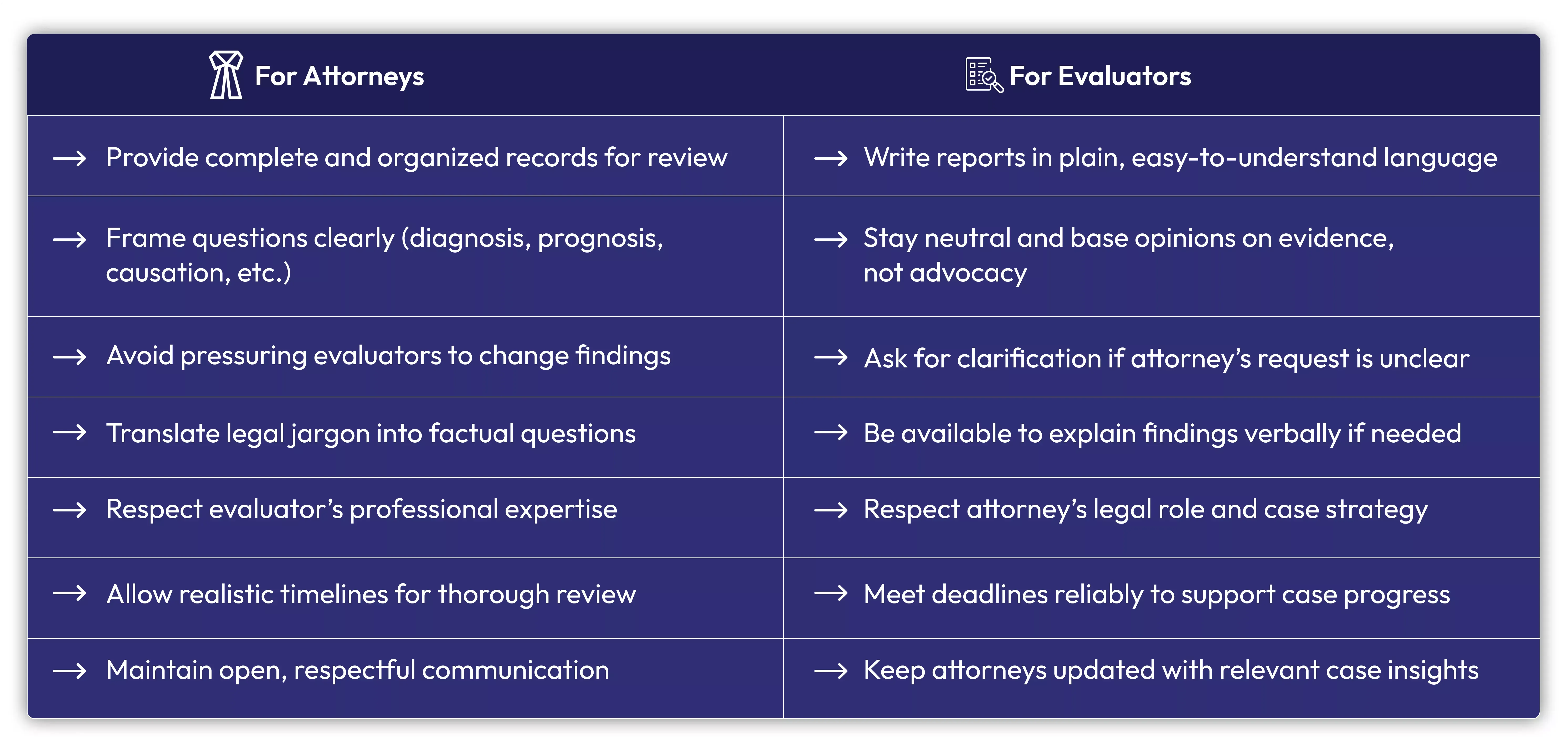
Provide evaluators with complete and organized records. Missing documents can lead to incomplete opinions. Their reports should not only be accurate but also structured in a way that is useful for legal purposes.
Frame questions clearly. Instead of asking for a “medical opinion,” specify whether you need information on diagnosis, causation, prognosis, or functional limitations.
Attorneys should never pressure evaluators to change their findings. Doing so can damage credibility in court and harm the case.
An attorney should avoid using legal jargon. While the case may involve legal questions, evaluators need them translated into factual questions they can address.
"Trust and communication are the backbone of every successful evaluator–attorney relationship—without them, even strong cases can fall apart."
Best Practices for Evaluators When Working with Attorneys
Write reports in plain, straightforward language whenever possible. Judges and juries may not understand technical terms.
Be willing to explain findings verbally, not just in writing. Attorneys often need to fully understand the opinion before presenting it in court.
Attorneys advocate for clients, and evaluators must remain neutral and base their opinions on evidence.
Ask for clarification if the attorney’s request is unclear. It is better to confirm than to assume.
How to Work Together Effectively
Strong relationships are built on everyday practices. Here are some ways attorneys and evaluators can improve their collaboration:
Regular updates about the case
Understand each other’s roles
Feedback and learning
Mutual reliability
Maintain open communication
Keep in mind that the ultimate aim is to present clear, accurate, and useful information to the court for a fair outcome.
Keys to a Strong Evaluator–Attorney Partnership
50%
Fewer Misunderstandings
Clear communication avoids confusion.
60%
Better Report Quality
Shared context leads to more accurate evaluations
40%
Faster Case Progress
Timelines and updates reduce last-minute stress
Frequently Asked Questions
Why are strong relationships between attorneys and evaluators important?
Strong attorney–evaluator relationships improve communication, reduce misunderstandings, and help produce clear, defensible opinions that support fair and effective case outcomes.
How does poor communication affect attorney–evaluator collaboration?
Poor communication can lead to incomplete records, unclear expectations, inaccurate evaluations, delays, and weakened case strategies.
What role do evaluators play in legal cases?
Evaluators provide independent, evidence-based opinions on medical, psychological, or technical issues that attorneys rely on to explain complex matters in court.
What challenges commonly arise between attorneys and evaluators?
Common challenges include limited communication, time pressure, budget constraints, and differences between legal and clinical professional cultures.
How can attorneys improve their relationship with evaluators?
Attorneys can improve collaboration by sharing complete records, asking clear questions, setting realistic timelines, and respecting evaluator neutrality.
How can evaluators support attorneys more effectively?
Evaluators can support attorneys by writing clear, plain-language reports, explaining findings verbally when needed, and asking for clarification on unclear requests.
Why is trust essential in attorney–evaluator relationships?
Trust ensures that evaluators provide honest, defensible opinions and that attorneys use those opinions responsibly, strengthening credibility in court.
How does clear communication improve case efficiency?
Clear communication reduces delays and misunderstandings, improving report accuracy and speeding up case progress by 50–60%.
Why should evaluators remain neutral when working with attorneys?
Neutrality preserves professional credibility and ensures opinions are based on evidence, not advocacy, which is critical for legal defensibility.
What are the keys to a successful attorney–evaluator partnership?
Open communication, mutual respect, transparency, consistent collaboration, and a shared focus on achieving fair legal outcomes are essential.
To sum up,
Challenges like poor communication, time pressures, and different professional cultures can make collaboration difficult. But with effort, transparency, and respect, these challenges can be overcome.
When evaluators and attorneys treat each other as partners, they not only strengthen their own work but also serve clients and the legal system more effectively.
Source Credit : All metrics derived from LezDo TechMed’s internal project data.
Jebisha Jenishofen
Jebisha Jenishofen is a Certified Legal Nurse Consultant and Medical–Legal Research Analyst with over five years of experience in the medical-legal industry. She specializes in medical record analysis, medical-legal research, and content development, creating clear and informative resources on personal injury, medical malpractice, insurance claims, and healthcare litigation. By combining clinical knowledge with research expertise, she transforms complex medical information into practical insights for medical-legal professionals.










.png)


